Free Standard Shipping on Orders $99.95+ and Free Rural Shipping on Orders $109.95+

Free Standard Shipping on Orders $99.95+ and Free Rural Shipping on Orders $109.95+
Last reviewed: September 2026
EzyVision is a retailer, not a clinical provider. Always follow your optometrist’s instructions and the lens manufacturer’s directions for use.
Quick answer: Hydrogel lenses carry oxygen to your eye mostly through the water they hold. Silicone hydrogel lenses use silicone instead, which lets through significantly more oxygen — often without needing high water content to do it. That’s silicone hydrogel’s clearest advantage. It doesn’t automatically make it more comfortable, safer, or better for dry eyes than a well-fitted hydrogel lens — the research doesn’t support that leap, and your optometrist is the one who can tell you which fits your eyes.
Key facts
A hydrogel lens is made from a water-attracting polymer, and oxygen reaches your cornea by dissolving through the water the lens holds. Within conventional hydrogel materials, more water generally means more oxygen can pass through. It’s an older technology than silicone hydrogel, but “older” doesn’t mean “worse” — hydrogel lenses are still a genuinely good fit for a lot of people, and remain widely used in both daily and reusable formats.
Silicone hydrogel lenses have silicone woven into the material itself. Silicone is naturally excellent at letting oxygen through, so these lenses can transmit far more oxygen than hydrogel — without depending on a high water content to do it. This is why some silicone hydrogel lenses actually have lower water percentages than hydrogel lenses, while still out-performing them on oxygen flow.
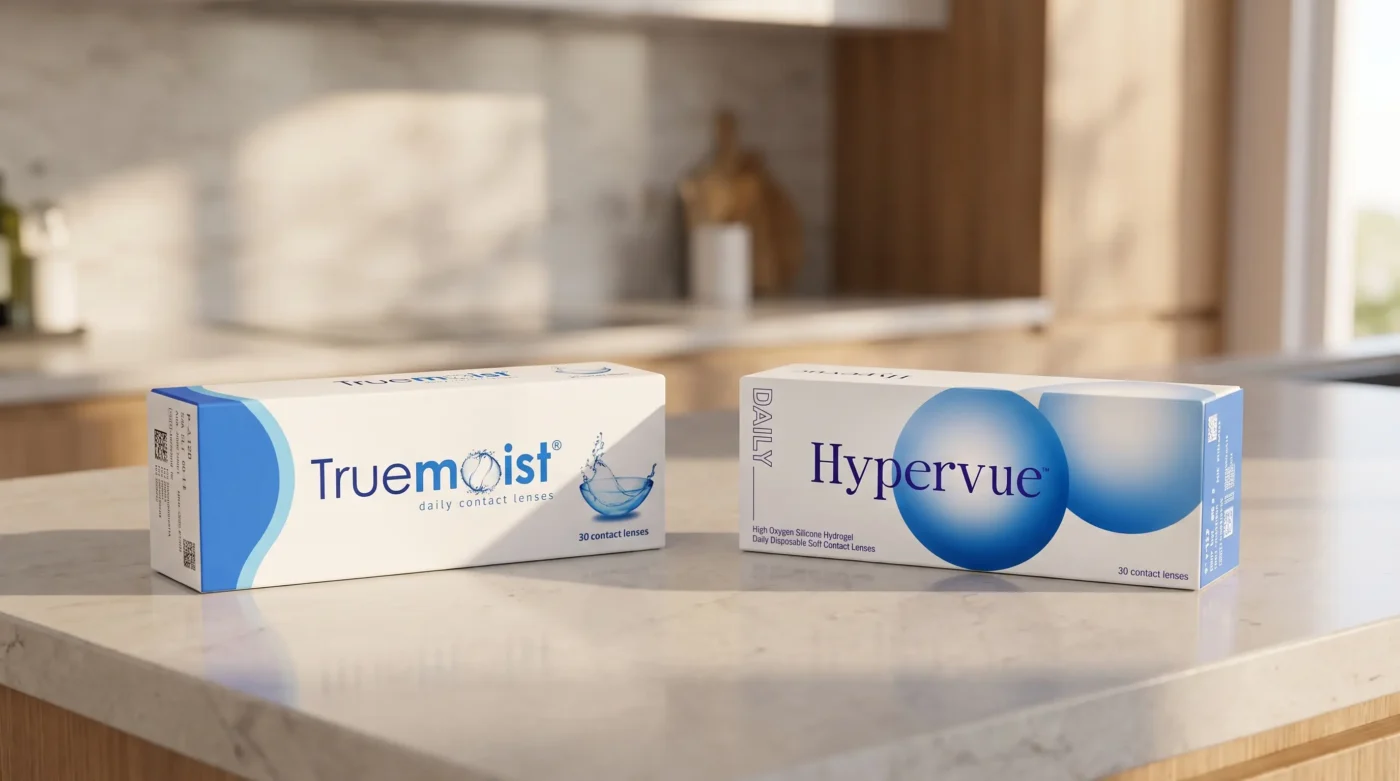
[Editorial note: this section can name specific EzyVision products and their confirmed material type once verified specs are pulled from supplier data — Hypervue and Perception are both marketed as silicone hydrogel, per current packaging; Truemoist’s material class needs confirming before it’s stated here.]
Your cornea has no blood vessels of its own — when your eyes are open, most of its oxygen comes straight from the air, and a contact lens sits directly between the air and your eye. That’s the entire reason lens material matters: the lens needs to let enough oxygen through to keep the cornea healthy while it’s being worn. Silicone hydrogel’s big contribution was closing the oxygen gap that older hydrogel lenses struggled with, and that’s a real, well-documented advantage of the technology. It’s just not the only factor that decides whether a lens is right for you.
You’ll sometimes see this on a spec sheet. Dk measures how oxygen-permeable the lens material is; t is the lens’s thickness. Dk/t together tells you how much oxygen actually gets through a lens of that specific thickness — generally, a higher number means more oxygen passes through. One caution worth knowing: lens thickness changes with prescription strength and lens design, so comparing Dk/t numbers across two different products isn’t always a clean like-for-like comparison. Treat it as one useful data point, not the whole decision.
Not automatically, and this trips a lot of people up. Within conventional hydrogel, yes — more water usually does mean more oxygen, because oxygen moves through the water inside the lens. Silicone hydrogel breaks that link, since most of its oxygen transport happens through the silicone rather than the water. That means a silicone hydrogel lens can carry a lower water percentage than a hydrogel lens and still deliver dramatically more oxygen. Reading the water-content number on its own won’t tell you which lens actually breathes better.
Not automatically. It’s an easy assumption to make — more oxygen sounds like it should mean more comfort — but the best current evidence doesn’t back it up. A Cochrane systematic review found the evidence comparing hydrogel and silicone hydrogel on comfort and overall safety was of very low certainty, not enough to declare either material the winner. That tracks, because comfort depends on a lot more than the base material: the lens surface, its design, how well it’s fitted, how often it’s replaced, deposit buildup on reusable lenses, your care routine, your own tear film, and your individual eyes all play a part. A well-fitted hydrogel lens can feel better to one person than a specific silicone hydrogel lens does — and the reverse is just as true for someone else.
Again, no single answer fits everyone. Dryness during lens wear usually comes down to your tear film, the lens surface, fit, your environment, and your replacement schedule — not oxygen flow in isolation. Some modern silicone hydrogel lenses include surface technology aimed at improving moisture and wettability, but this varies by product, not by material class alone. If your current lenses are starting to feel dry, uncomfortable, or hard to wear, that’s worth a conversation with your optometrist rather than switching materials based on a comparison article — this one included.
There’s no universally “right” material. A hydrogel lens can still be the right call if your current pair fits well, you’re happy with your vision and comfort, or your optometrist has specifically recommended it — newer technology doesn’t make an already-good fit outdated. Silicone hydrogel is worth considering if higher oxygen flow matters to you, your optometrist recommends a higher-oxygen lens, or the design that suits your prescription happens to be silicone hydrogel. Either way, the material is one part of the picture — fit, diameter, base curve, surface design and your own eyes all matter too, and two lenses with the same prescription power aren’t automatically interchangeable.
Not automatically, no matter how much oxygen the lens lets through. Daily-wear lenses are designed to come out before bed. Some specific products do have an approved extended-wear schedule, but that depends entirely on the individual lens and your eye-care provider’s advice — not simply on whether it’s silicone hydrogel. The CDC recommends against sleeping in contact lenses unless your eye-care provider has told you it’s safe for your specific lens, since doing so raises your risk of eye infection. If you’re ever unsure, check the manufacturer’s instructions and check with your optometrist.
“Higher water content always means a more breathable lens.” True for conventional hydrogel, not for silicone hydrogel, which carries most of its oxygen through silicone rather than water.
“Silicone hydrogel is always more comfortable.” The evidence doesn’t support this as a blanket claim.
“Silicone hydrogel is automatically better for dry eyes.” Not necessarily — dry-eye comfort depends on far more than oxygen flow alone.
“Any silicone hydrogel lens can be slept in.” No — wearing schedules are product-specific, and sleeping in lenses raises infection risk.
“Same prescription power means I can swap freely between lenses.” Not automatically — material, fit, diameter, base curve and design can all differ even at the same power.
If you’re noticing dryness, redness, discomfort, or your lenses aren’t lasting as long through the day as they used to, that’s a conversation for your optometrist, not a decision to make from a materials comparison alone. The same goes for switching materials or brands, or considering any kind of extended or overnight wear — your optometrist is the one who can assess your eyes and tell you what’s actually suited to them.
What’s the main difference between hydrogel and silicone hydrogel contacts? How each carries oxygen to your eye — hydrogel mainly through the water it holds, silicone hydrogel mainly through the silicone in the material.
Which lets through more oxygen — hydrogel or silicone hydrogel? Silicone hydrogel generally offers significantly higher oxygen transmissibility than conventional hydrogel.
Is silicone hydrogel more comfortable than hydrogel? Not necessarily — current systematic-review evidence doesn’t show a clear comfort advantage either way.
Does higher water content mean a better lens? Not automatically. Water content affects hydrogel and silicone hydrogel differently, so it shouldn’t be used alone to judge oxygen flow or performance.
Can I switch from hydrogel to silicone hydrogel on the same prescription? Don’t assume they’re interchangeable just because the power matches — material, design, base curve and diameter can differ. Talk to your optometrist before switching.
Can I sleep in silicone hydrogel lenses? Only if your specific lens has an approved wearing schedule and your optometrist has told you it’s fine for you. Being silicone hydrogel doesn’t make a lens automatically safe for overnight wear.
Sources: Cochrane systematic review, published research summary, CDC — About Contact Lens Types